Market Update | June 2026
The Local Lowdown: North Bay
- Prices are rising across much of the Bay Area, with San Francisco single-family homes breaching the $2.2 million mark for the first time and the East Bay posting gains across both single-family homes and condos for the first time in over a year.
- Inventory levels have plummeted across the region, with year-over-year declines ranging from nearly 19% in Silicon Valley to more than 44% in San Francisco, leaving buyers with extremely limited options heading into summer.
- Single-family homes are selling in roughly two weeks or less throughout the Bay Area, while the condo market is showing signs of improvement in several sub-markets.
- The single-family home market is firmly in seller's territory across virtually every county, while the condo market remains more favorable for buyers in several East Bay and North Bay markets.
Note: You can find the charts/graphs for the Local Lowdown at the end of this section.
Prices are climbing as the Bay Area heads into summer
May brought positive momentum to much of the Bay Area's single-family home market, with several notable milestones along the way. San Francisco's median single-family home sale price soared 22.56% year-over-year to $2,200,000, marking one of the strongest gains in the market's recent history. In Silicon Valley, San Mateo County posted an impressive 6.87% year-over-year increase to $2,210,000, though Santa Clara County pulled back 5.58% to $2,050,000 and Santa Cruz County declined 6.38% to $1,254,500. The East Bay delivered a welcome surprise, as both Alameda and Contra Costa Counties posted year-over-year gains of 2.96% and 2.50%, respectively.
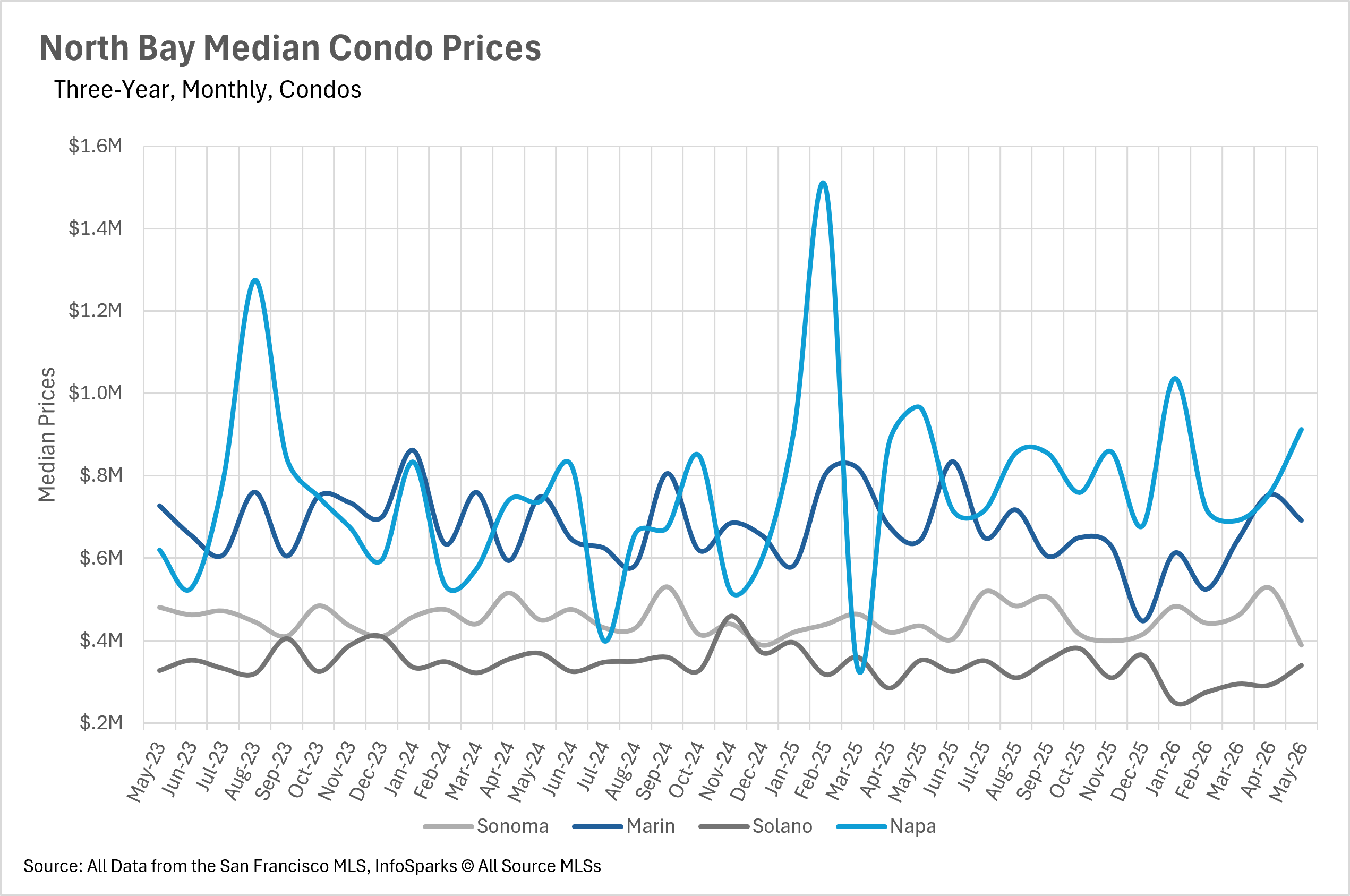
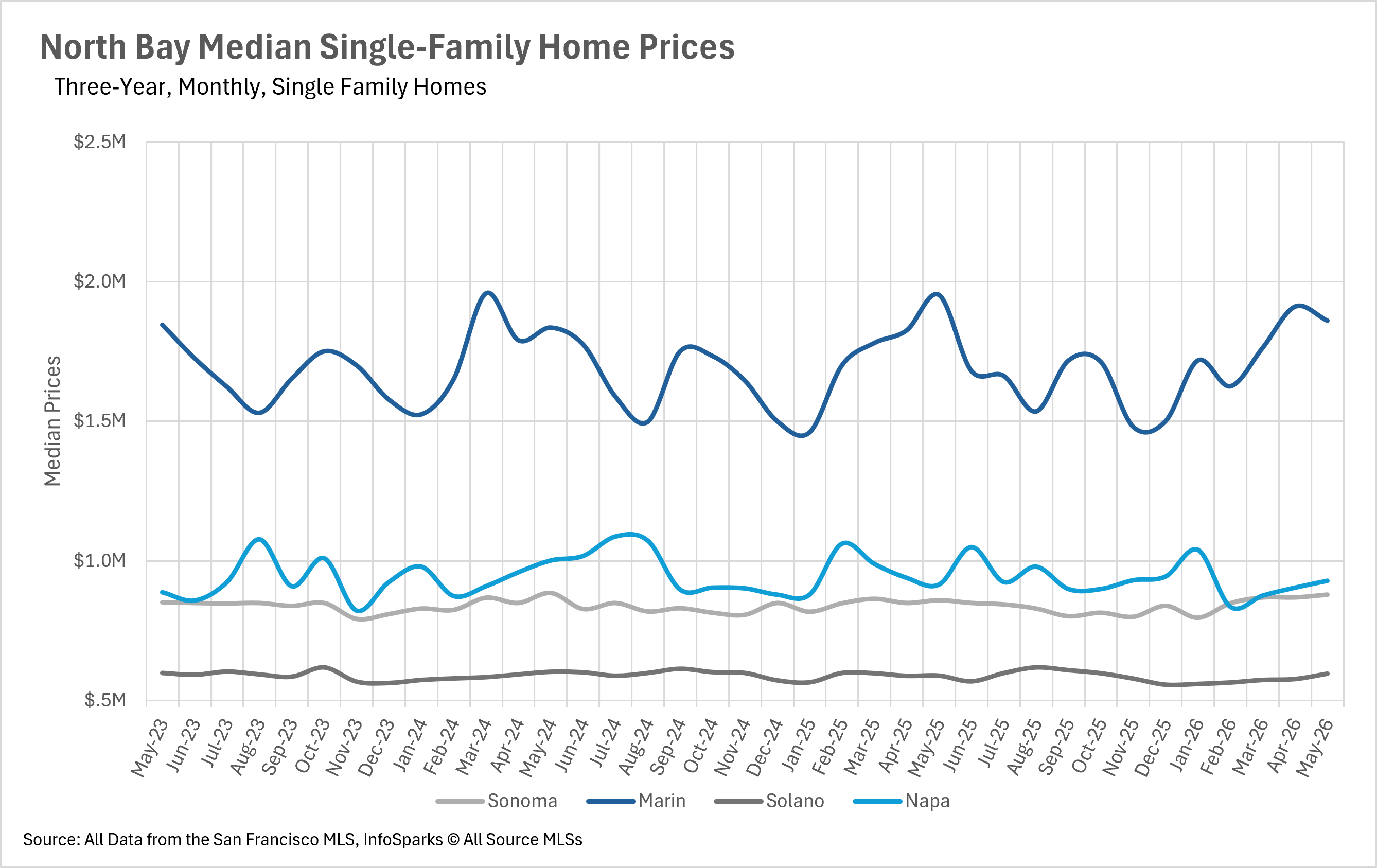
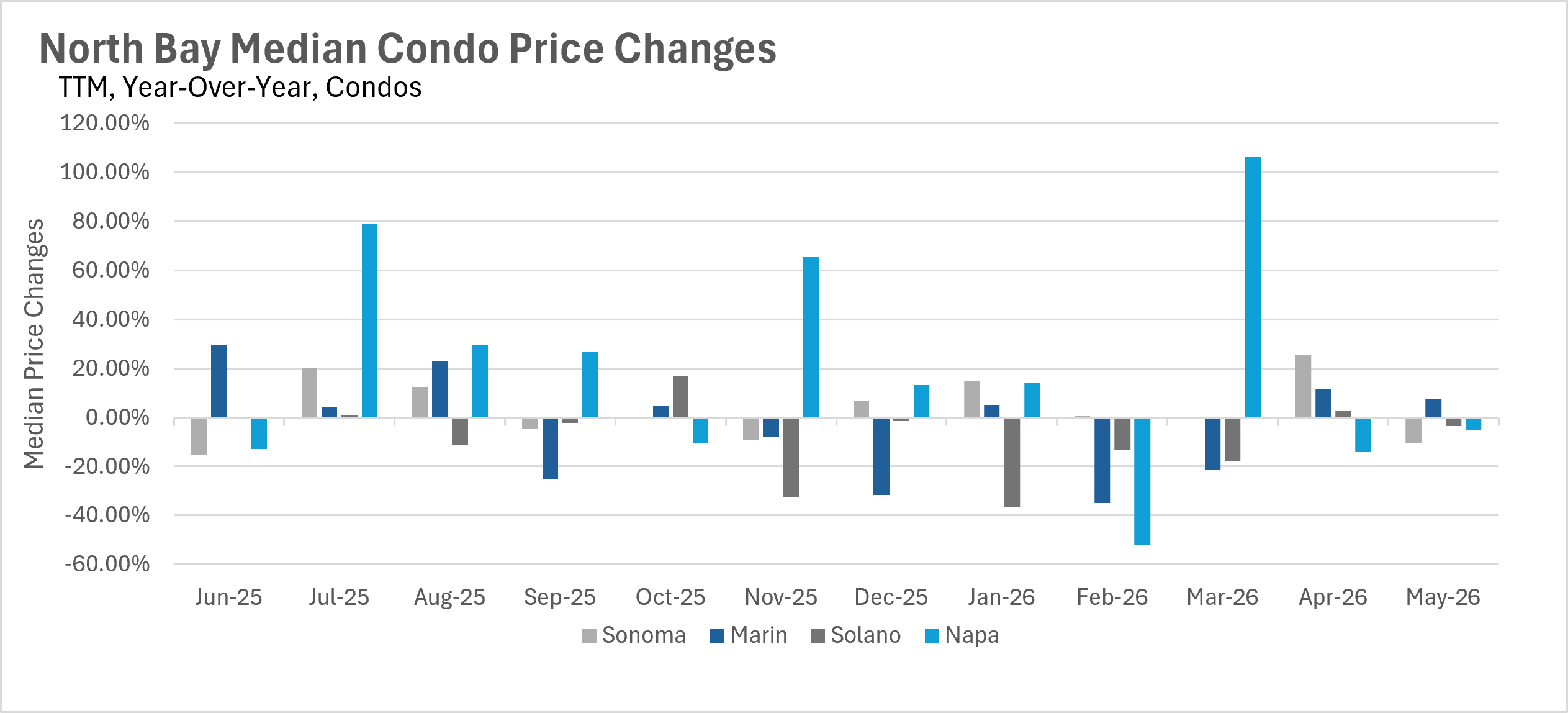
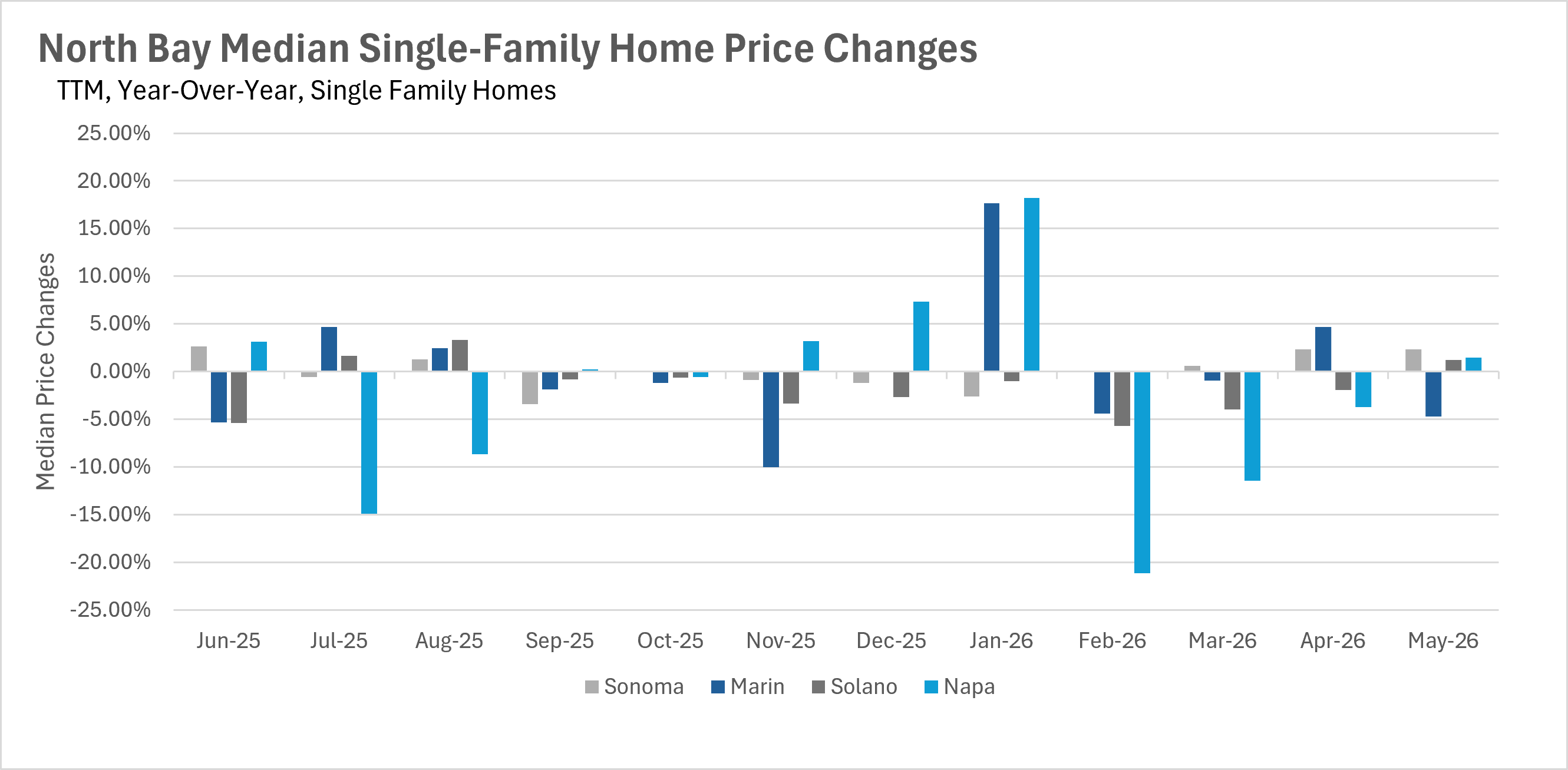
Three of the four North Bay counties also saw gains, with Sonoma County up 2.33%, Napa County up 1.47%, and Solano County up 1.19%, though Marin County declined 4.70%. On the condo side, the East Bay stood out as both counties posted positive year-over-year growth for the first time in quite some time. Silicon Valley's condo market was a wild card, with San Mateo County condos surging 24.06% and Santa Cruz County condos skyrocketing 36.51%, while Santa Clara County condos continued to decline by 8.85%.
Inventory has reached critically low levels across the Bay Area
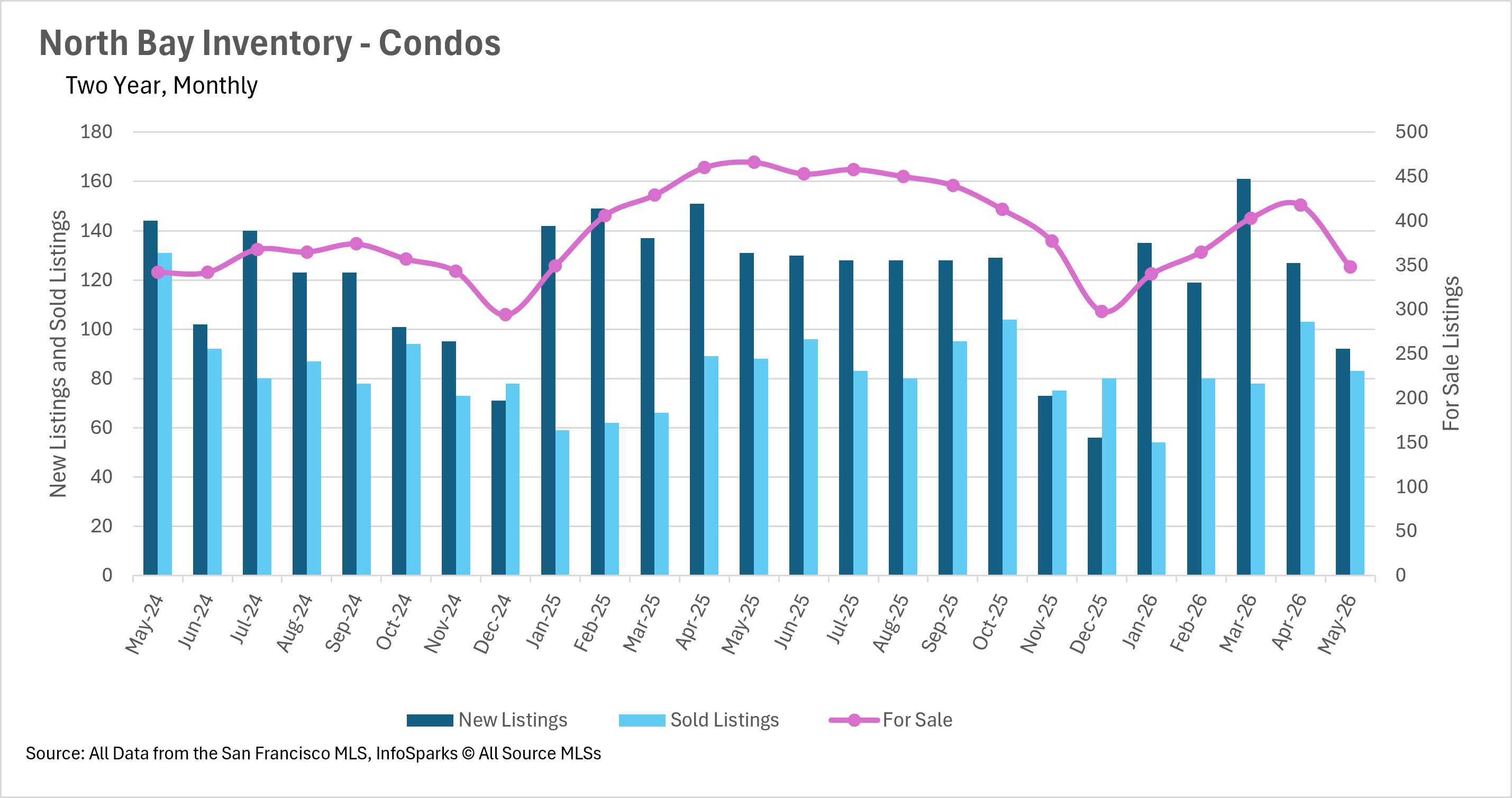
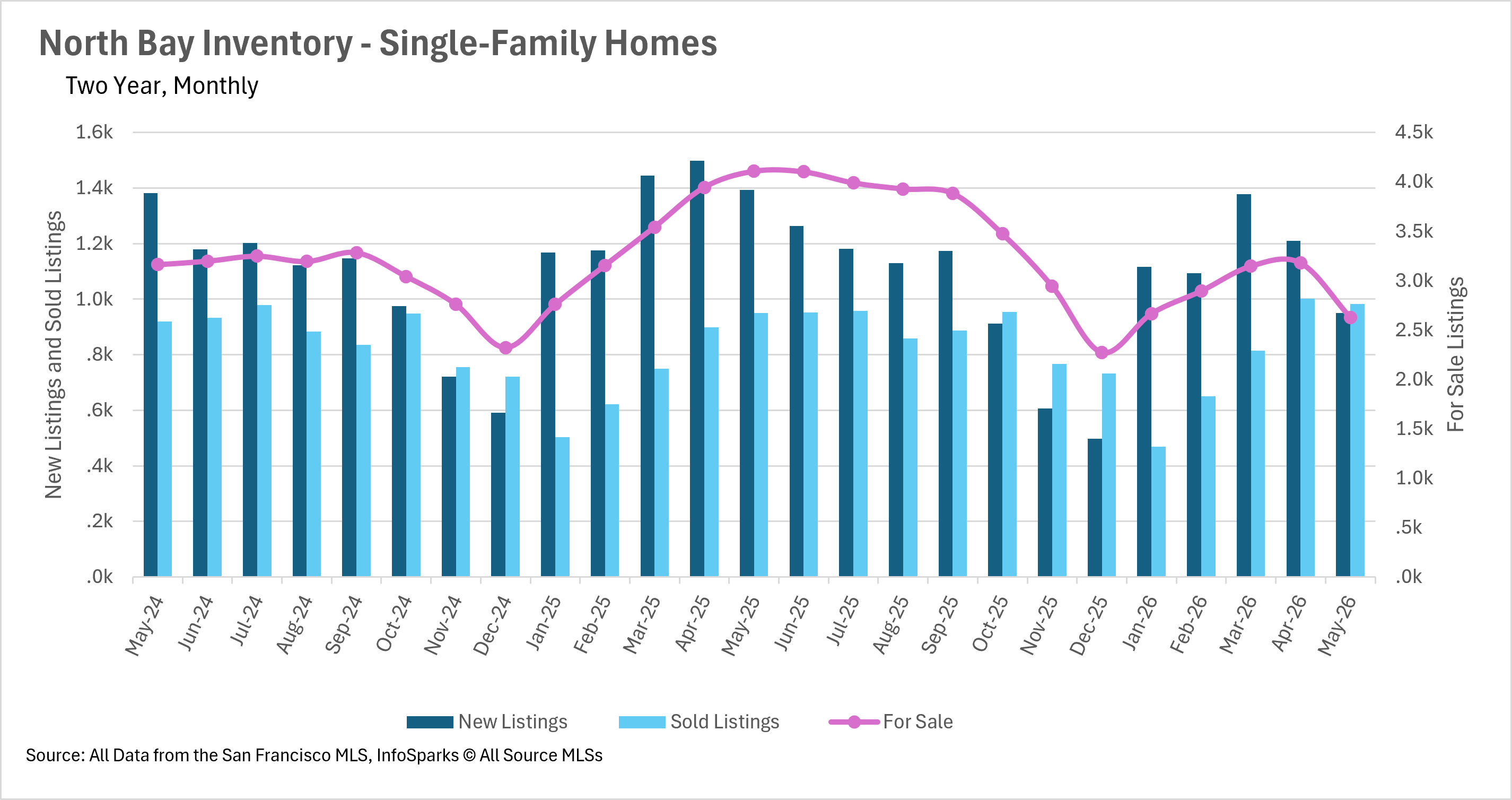
The inventory shortage that has defined the Bay Area market throughout 2026 has only intensified as we move into the summer selling season. San Francisco is experiencing the most severe crunch, with single-family inventory down a staggering 44.62% year-over-year and condo inventory down 37.96%, leaving fewer than 700 homes available for sale in the entire city. The North Bay is also feeling the squeeze, with single-family home inventory down 36% and condo inventory down 25.32%.
The East Bay has seen single-family inventory decline by 27.38% and condo inventory drop by 12.59%, while Silicon Valley's single-family inventory is down 18.94% and condo inventory is down 9.77%. New listings continue to trail last year's pace in most markets, with the North Bay seeing single-family new listings down 31.73% and Silicon Valley down 11.79%. On the demand side, sold listings are actually up in several markets, with Silicon Valley single-family sales up 4.47% and North Bay single-family sales up 3.37%. This combination of declining supply and steady or growing demand is the primary driver behind the price appreciation we're seeing across much of the region.
Single-family homes are selling quickly, and the condo market is picking up speed
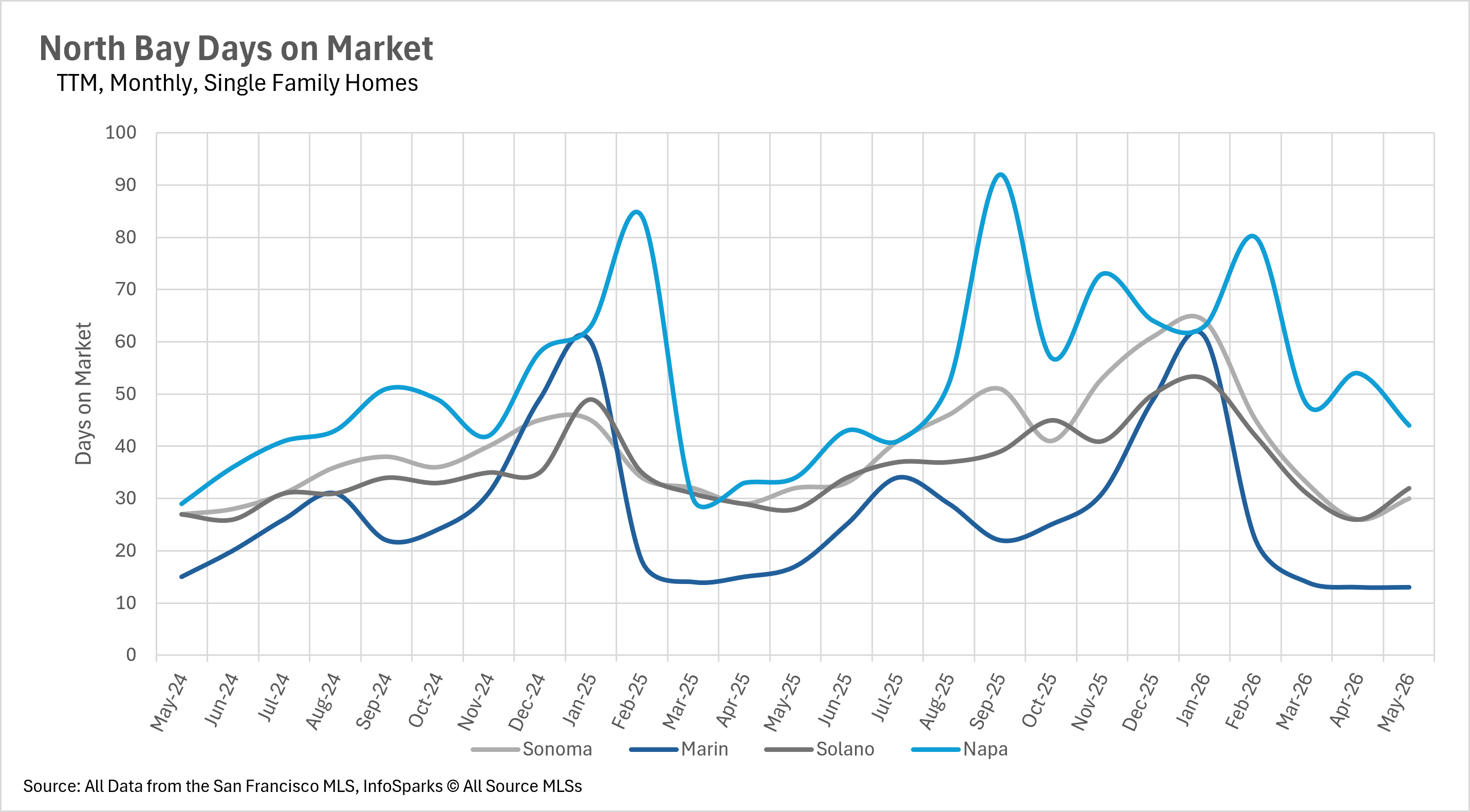
The pace of sales for single-family homes across the Bay Area remains remarkably fast as the summer selling season approaches. San Francisco single-family homes are selling in just 12 days, while Santa Clara County homes are moving in 11 days and San Mateo County homes in 12 days. In the East Bay, single-family homes in both Alameda and Contra Costa Counties are selling in just 13 days, a 7.14% improvement compared to last year.
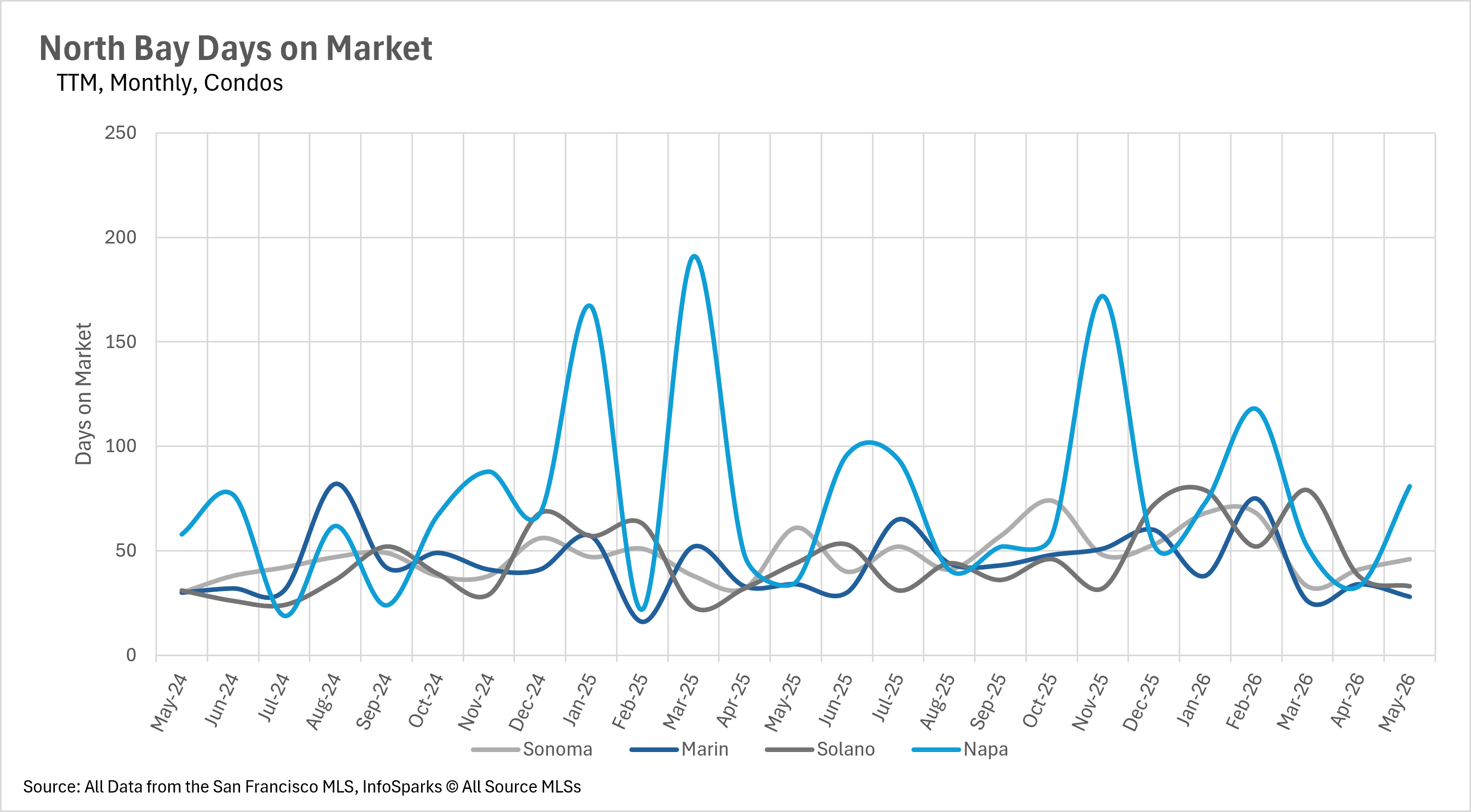
The North Bay saw impressive velocity as well, with Marin County single-family homes selling in just 13 days, a 23.53% improvement year-over-year, and Sonoma County homes moving 6.25% faster at 30 days. The condo market is also showing encouraging signs of improvement in several markets. San Mateo County condos are selling 15.15% faster than last year, Santa Cruz County condos are moving 37.84% faster, and North Bay condos in Sonoma, Solano, and Marin Counties are all selling considerably more quickly than they were a year ago. San Francisco condos are now selling in just 16 days, a 38.46% year-over-year decline. The notable exception is Napa County, where condos are spending 131.43% more time on the market at a median of 81 days.
Sellers continue to dominate the single-family market heading into summer
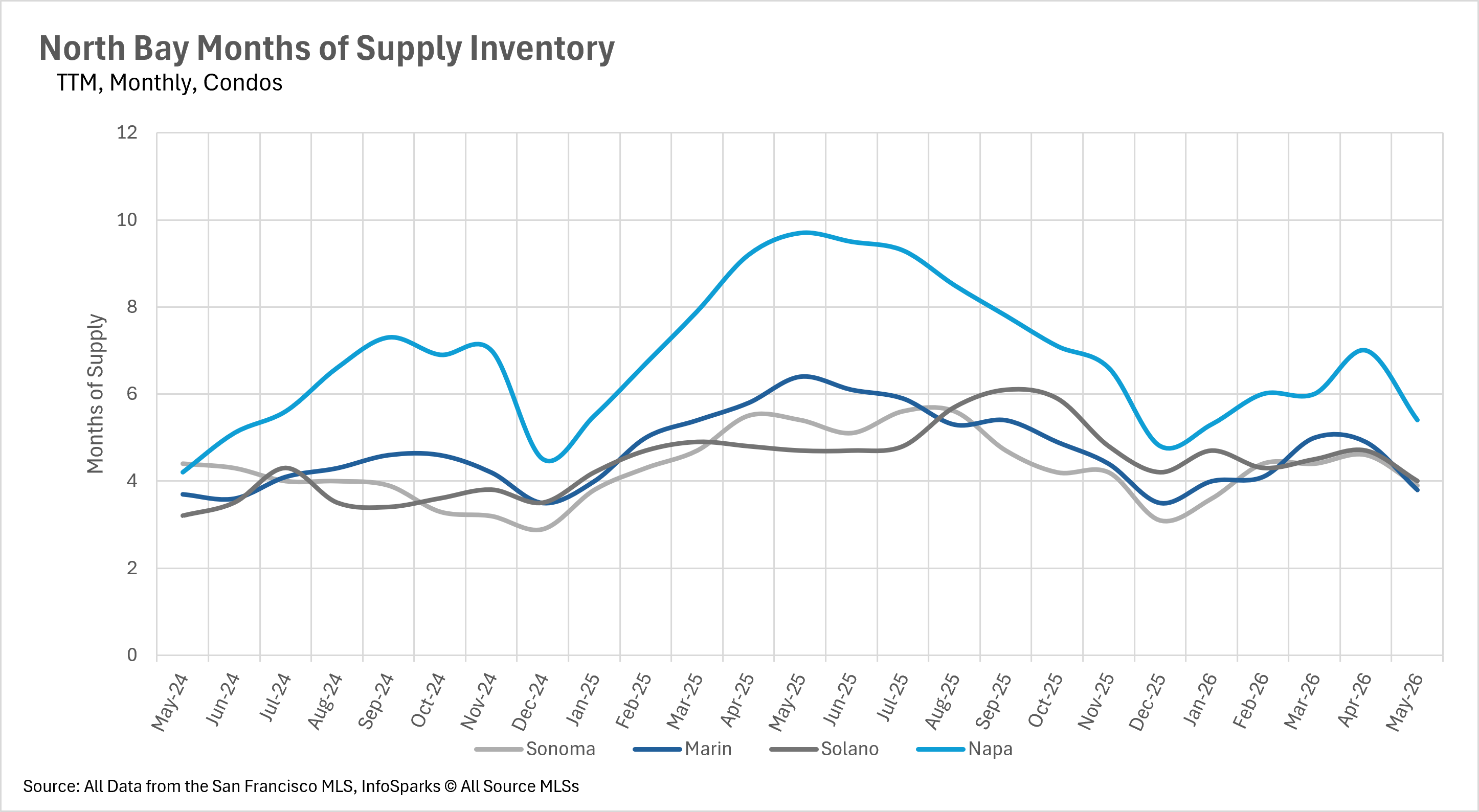
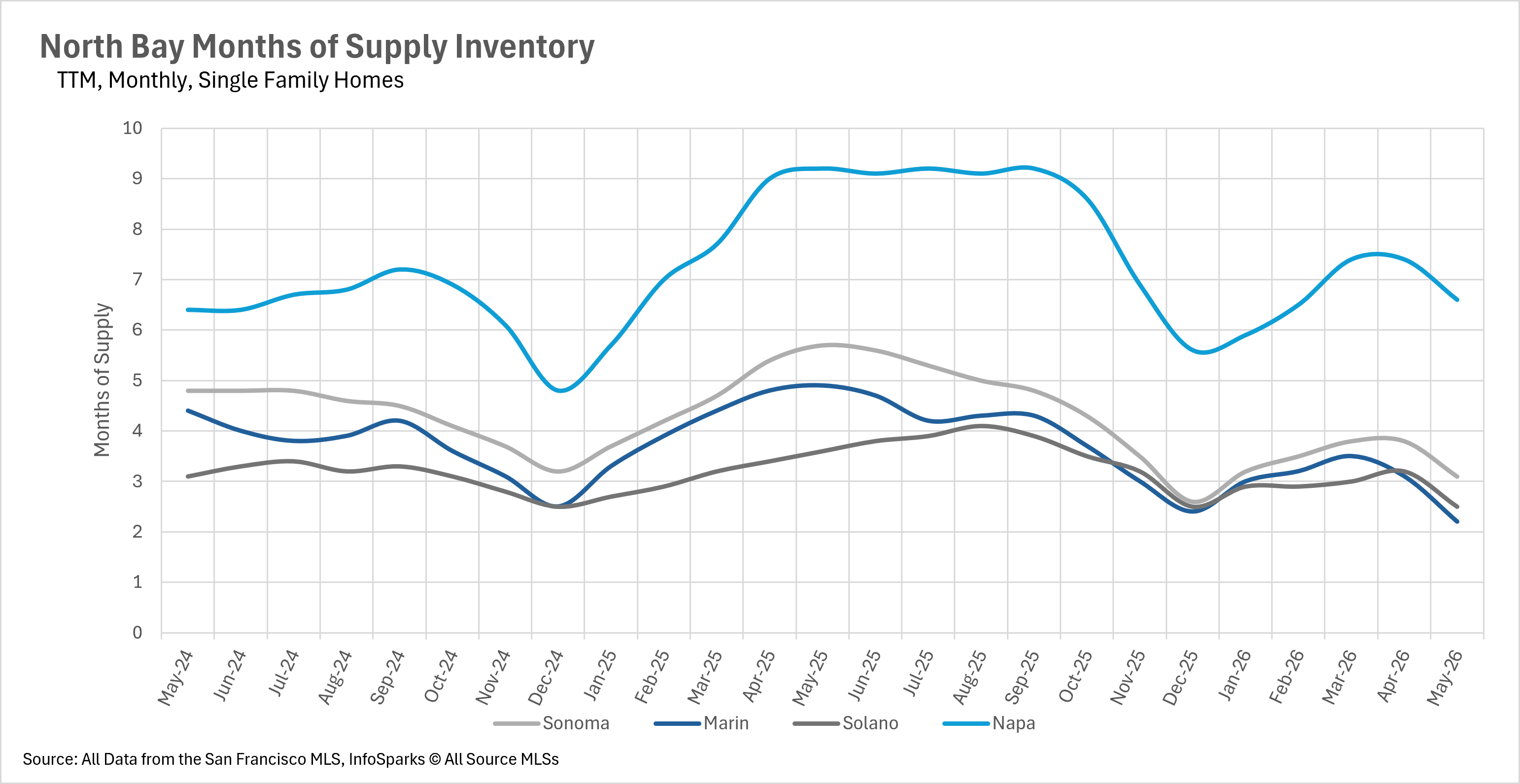
When determining whether a market is a buyers' market or a sellers' market, we look to the Months of Supply Inventory (MSI) metric. The state of California has historically averaged around three months of MSI, so any area with at or around three months of MSI is considered a balanced market. Any market that has lower than three months of MSI is considered a seller's market, whereas markets with more than three months of MSI are considered a buyers' market.
The single-family home market is deeply entrenched in seller's territory across the Bay Area as we head into summer. San Francisco sits at just 1.1 months of supply, down nearly 48% year-over-year. San Mateo County has 1.4 months of supply, down a dramatic 39.13%, while Santa Clara County has 1.8 months, down 10%. Alameda County sits at 1.9 months, Marin County at 2.2 months, Contra Costa County at 2.3 months, Solano County at 2.5 months, Sonoma County at 3.1 months, and Santa Cruz County at 3.1 months. Napa County remains the lone buyer's market at 6.6 months, though even that figure is down 28.26% year-over-year.
The condo market continues to offer more balance for buyers. San Francisco's condo market has fully transformed from buyer's territory last year at 4.4 months to a strong seller's market at just 2.3 months. However, most other areas remain in buyer's or balanced territory, with Alameda County at 4.4 months, Contra Costa County at 4.2 months, Santa Clara County at 4.3 months, Napa County at 5.4 months, and Solano County at 4 months. As we head into the busiest season of the year, sellers in the single-family home market are positioned to enjoy significant leverage across nearly every corner of the Bay Area.
Looking Ahead
The North Bay enters the second half of the year on solid footing. Limited inventory, steady buyer demand, and fast-moving sales continue to support a competitive housing market. As we move through the summer, we'll be watching inventory levels, buyer activity, and pricing trends closely to see how the market evolves.
If you're considering buying or selling in Marin County, we'd be happy to discuss what these market trends mean for your specific goals. Contact us for a personalized market analysis or a complimentary home value assessment.